
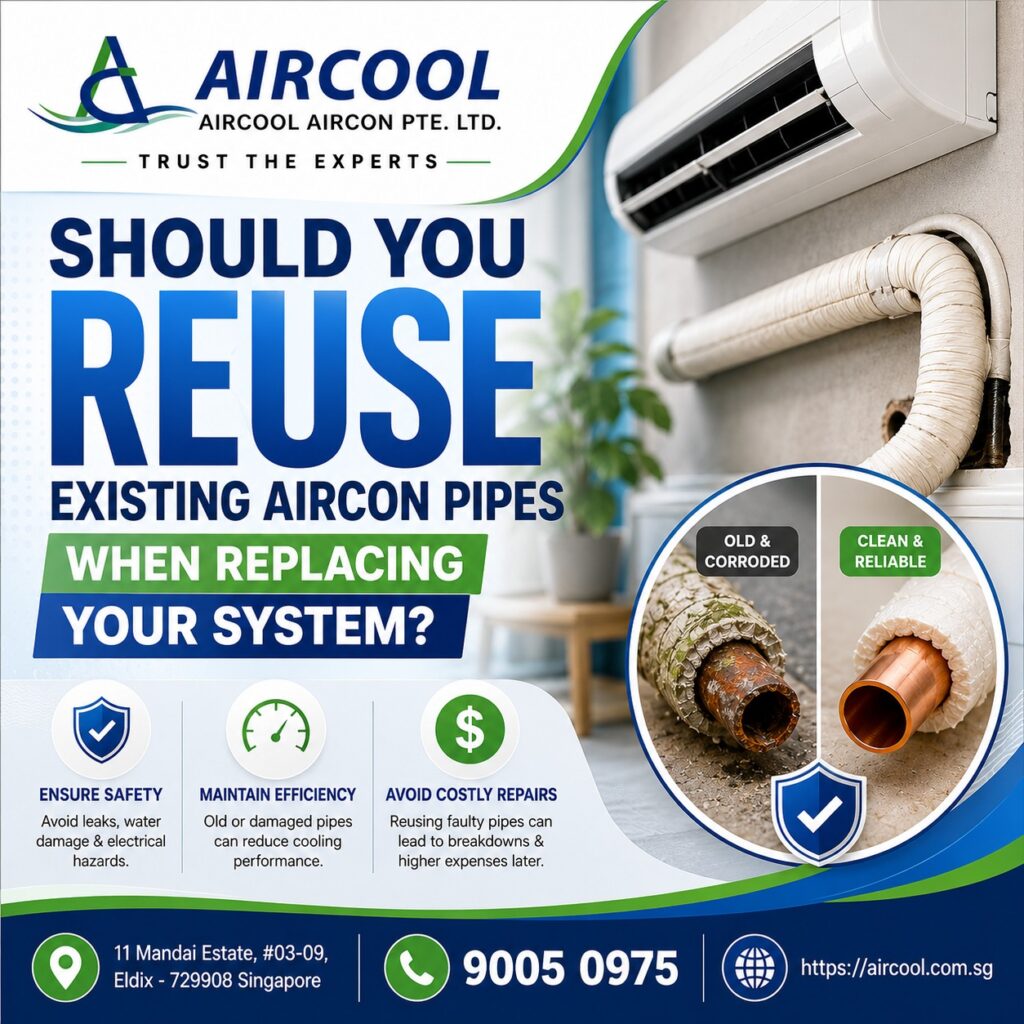
Reuse existing aircon pipes
Buying a new air conditioner is a major investment that promises better cooling, lower energy bills, and a more comfortable home. However, when you start talking to contractors and getting quotes, you will likely face a confusing question: Is it okay to reuse the old copper pipes for the new aircon system?
At first glance, keeping your old pipes seems like a brilliant way to save money. By reusing existing infrastructure, you can often shave several hundred dollars off your installation bill. You also avoid the mess and hassle of opening up false ceilings, hacking into walls, or repainting areas where new trunking (the plastic casing for pipes) would need to be installed. For many homeowners, especially those living in high-rise apartments or recently renovated homes, the idea of avoiding a “major construction project” is very appealing.
However, this shortcut can lead to devastating and expensive repairs just a few years down the road. An air conditioner is a complex machine, and the pipes are its “circulatory system.” If that system is clogged or damaged, even the most expensive new unit will fail. This comprehensive guide will take a deep dive into how your aircon piping works, the technical requirements of modern refrigerants, the hidden risks of old materials, and a step-by-step decision-making process to help you choose the best path for your home.
Understanding Your Aircon Piping
To make an informed choice, you need to understand exactly what is hidden behind your walls and ceilings. A standard split-type aircon system relies on three critical components that make up the “piping set”:
- Copper Pipes (Refrigerant Lines): These are the most important part. They form a closed loop between your indoor fan coil unit and the outdoor condenser. These pipes carry the refrigerant gas that actually absorbs heat from your room and moves it outside. Copper is used because it handles heat well and is flexible, but it can degrade over time.
- Thermal Insulation (Armaflex/Foam): This is the black or grey foam tube that wraps around each copper pipe. Its job is to prevent the cold copper from touching the warm air. Without good insulation, the pipes will “sweat”—forming condensation that drips onto your ceiling or inside your walls, leading to mold growth and structural damage.
- Drainage Hoses (PVC Pipes): When your aircon cools the air, it also removes moisture (dehumidification). This water collects in a tray and must flow out through a PVC drain pipe. If this pipe is clogged with slime or is angled incorrectly, water will leak from your indoor unit onto your floor or furniture.
Because these pipes are usually embedded in concrete or hidden above expensive false ceilings, replacing them is labor-intensive. It often requires “trunking”—visible plastic covers that run along your walls—if you don’t want to tear down your ceiling. This aesthetic concern is the primary reason why homeowners ask to reuse old pipes.
Refer : Aircon Piping Installation guide
Signs of Aging: A Checklist for Homeowners
Before you decide, you can perform a basic physical inspection of your current system. Look for these warning signs that your pipes are nearing the end of their life:
- Yellowish Stains on the Ceiling: If you see watermarks near where your aircon pipes run, your insulation has likely failed. Reusing pipes that are already “sweating” is a recipe for disaster.
- Brittle or Crumbling Foam: If you can see the pipes (near the outdoor unit), touch the black foam. If it feels hard, cracks easily, or is falling apart, it can no longer protect the pipes.
- Oily Residue at Joints: Look at the connection points on your outdoor unit. If you see a dark, oily stain, it means refrigerant gas is leaking out. Gas carries oil, and wherever gas leaks, oil leaves a mark.
- Frequent Topping Up of Gas: A healthy aircon system should never need a “gas top-up.” If you have had to add gas every year, your pipes have tiny holes (micro-leaks).
- The “Slap” Sound: If you hear water “slapping” or gurgling inside the walls when the aircon starts, your drain pipes might be partially clogged or have improper sloping.
Is Your Current Piping Ready?
If you’re installing a new unit, proper aircon installation is just as important as choosing the right equipment. A new aircon should last 10 to 15 years. It isn’t just about the unit on the wall; the whole system must work perfectly together. If your old unit stopped cooling well, the pipes might be part of the problem. Connecting a new unit to bad pipes means you won’t get the cooling you paid for.
When Can You Safely Reuse Pipes?
In the industry, we generally recommend replacement if pipes are older than 8 years. However, you can consider keeping them ONLY if they pass these rigorous technical tests:
1. The Copper is Healthy
The pipes should have no history of leaks, no rust, and no deep dents. They are usable only if they have been reliable in the past.
2. The Metal is Thick Enough
Older aircon systems (using R22 gas) operated at much lower pressures. Modern eco-friendly units (using R410A or R32 gas) operate at significantly higher pressures. To handle this, your copper must be thick enough. In Singapore and many other regions, the standard for high-pressure gas is G22 gauge (0.71mm thickness). If your old pipes are G23 (0.61mm) or thinner, they may literally burst under the pressure of a new system.
3. The Sizes Are Correct
New units need specific pipe widths. If your new unit requires a larger pipe than you currently have, forcing gas through a small pipe will break the compressor.
4. Everything is Professionally Cleaned
This is the most critical step. If you reuse pipes, you MUST ensure they are flushed. Think of this like cleaning a car engine before switching to a different type of fuel. Any leftover dirt, moisture, or old oil must be completely removed to prevent contamination of the new system.
What Happens During a Professional Pipe Flushing?
When a contractor says they will “flush the lines,” they shouldn’t just be blowing air through them. Here is what a professional process looks like so you can verify their work:
- Chemical Cleaning: A special solvent is pumped through the copper lines. This solvent dissolves old, sticky mineral oil that clings to the pipe walls.
- Nitrogen Purging: High-pressure nitrogen gas is then blown through the pipes. Nitrogen is “dry”—it pushes out the chemical solvent along with any loosened debris or moisture. This is much better than using a regular air compressor, which actually adds moisture to the pipes.
- Pressure Testing: After cleaning, the technician should seal the pipes and leave them under high pressure for at least 30 minutes. If the gauge drops, there is a leak somewhere in the wall, and the pipes must be replaced.
- Vacuuming: Finally, a vacuum pump is used to suck out all air and non-condensable gases, leaving the pipes perfectly clean and ready for the new refrigerant.
The Dangers of Using Old Pipes
Regular aircon servicing can help identify pipe deterioration before it causes expensive failures.
1. Oil Mixtures Can Break the System
The single biggest killer of new aircons is “Oil Incompatibility.” Old R22 units used mineral oil, while modern R32 units use synthetic (POE) oil. If even a small amount of old mineral oil remains in the pipes, it reacts with the new refrigerant to create a thick, waxy sludge. This sludge blocks the expansion valve and causes the compressor to overheat and burn out. Replacing a compressor is the most expensive repair possible, often costing half the price of a new system.
2. Leaks Hidden in Walls
Copper gets weak over time. Tiny cracks can hide inside your walls. If you reuse old lines, you might find your new aircon blowing warm air after just a few months due to leaks.
3. Worn-Out Insulation
Old foam insulation can harden and fail. This causes pipes to “sweat” inside your walls, leading to mold, rotted wood, and ugly water stains on your ceiling.
The Hidden Costs of Keeping Old Pipes
While you might save $500 on installation today, let’s look at the “Total Cost of Ownership” over the next 10 years:
- Energy Inefficiency: If your old pipes have internal scaling or dents, the gas cannot flow smoothly. Your new “5-tick” energy-efficient aircon will have to work 20% harder to move the same amount of heat. This can add $10-$20 to your electricity bill every single month. Over 10 years, that is $1,200 to $2,400 wasted.
- Shortened Lifespan: An aircon on new pipes lasts 12-15 years. An aircon on old, partially clogged pipes might only last 7-8 years. You will end up buying a whole new system much sooner than expected.
- The “Double Work” Cost: Delaying repairs often results in costly aircon repair work that could have been avoided.
The “Peace of Mind” Factor
There is an intangible value to starting fresh. When you install new pipes, you get a “full system warranty.” If you reuse old pipes and a leak occurs, the manufacturer (like Daikin or Mitsubishi) will often blame the old pipes and refuse to cover the repair. By replacing the pipes, you ensure that if anything goes wrong, it is the installer’s or manufacturer’s responsibility to fix it for free. You can sleep soundly knowing that your home won’t have sudden water leaks or cooling failures during a heatwave.
| Comparison Feature | Reusing Old Pipes | Installing New Pipes |
|---|---|---|
| Upfront Cost | Lower | Higher |
| Installation Time | Faster (3 to 5 hours) | Longer (1 to 2 days) |
| Compressor Damage Risk | High | Zero (fresh, clean lines) |
| Cooling Efficiency | Risk of reduced power | Maximum HVAC system efficiency |
| Warranty Protection | May void manufacturer coverage | Full warranty protection |
| Expected Lifespan | Unknown | 10 to 15+ years |
How Piping Changes Your Total Cost
When budgeting, compare the cost of new pipes against these potential repair bills:
- New compressor: $800 – $1,200
- Fixing gas leaks: $200 – $450
- Ceiling repairs: $500 – $1,500
- Higher electricity bills: Due to low efficiency
Saving on materials today often leads to emergency costs later. Also, brands like Daikin or Mitsubishi may not honor your warranty if the damage was caused by old, dirty pipes.
Save Money with Better Efficiency
Routine aircon maintenance helps keep your cooling system running efficiently and extends its lifespan. If gas has to push through old pipes with oil or dents, the system works harder and your electricity bills go up.
New, thick insulation ensures the air stays cold all the way to your room. This keeps your monthly bills low and the system running efficiently.
5 Questions for Your Installer
Ask these five questions before the work begins:
- Are the old pipes thick enough for the new high-pressure gas?
- Will you do a pressure test to check for hidden leaks?
- How will you clean the old lines so the oil doesn’t mix?
- Is the insulation still dry and in good condition?
- Will reusing these pipes void my new warranty?
If the technician doesn’t want to test the pipes, it is much safer to just replace them.
Summary: What Should You Do?
- KEEP old pipes ONLY IF: They are less than 7 years old, thick enough, leak-free, have dry insulation, and are professionally flushed. This is best if your home was recently renovated.
- REPLACE with new pipes IF: They are over 8 years old, have leaked before, use old gas types, or show signs of sweating.
Frequently Asked Questions (FAQ)
Why can’t I just clean the pipes myself with a vacuum?
Household vacuums or air compressors aren’t strong enough to remove the oily film inside copper. You need industrial-grade solvents and high-pressure nitrogen to truly decontaminate the lines.
My contractor says it’s perfectly fine to reuse them. Should I trust them?
Contractors sometimes suggest reusing pipes because it makes their quote look cheaper, helping them win the job. Others want to avoid the “messy” work of installing new trunking. Always ask for a written guarantee that they have checked the gauge thickness and performed a nitrogen pressure test.
Will new pipes look ugly in my house?
Modern PVC trunking is very slim and can be painted to match your wall color. A professional installer can often hide the pipes behind curtains, wardrobes, or along the cornices so they are barely noticeable.
What if my pipes are inside the concrete slab?
In some condos, pipes are embedded in concrete. In this case, you can’t “replace” them without major hacking. Professional flushing is your only option here, or you may need to run new visible pipes (trunking) along the ceiling.
For most people, getting new pipes is the best move. It protects your investment, keeps your warranty safe, and ensures your aircon works perfectly for a long time.