
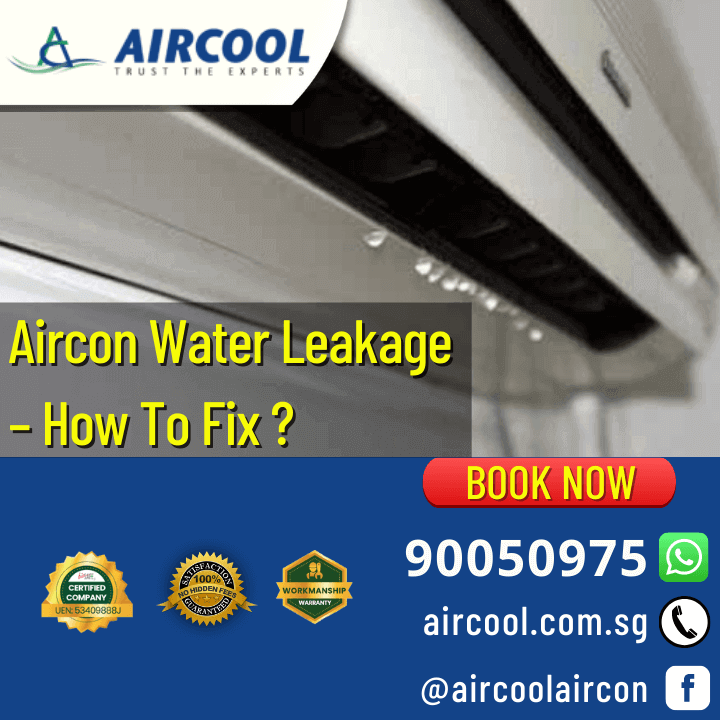
If your aircon is leaking water from the indoor unit, do not ignore it. A small drip may be caused by a blocked drainage line or a dirty filter, but ongoing water leakage can also point to issues with the drain pan, evaporator coil, drainage system, refrigerant level, or installation.
In Singapore, air conditioners work frequently because of our warm and humid weather. Regular use means dust, dirt, and moisture can gradually build up inside the unit and drainage system.
The good news is that many aircon water leakage problems can be identified and repaired once the actual cause is found.
This guide explains why aircon units leak water, what you can safely check yourself, when professional repair is needed, and how regular aircon servicing can help prevent the problem from returning.
Aircon Water Leaking? What Should You Do First?
If water is dripping from your indoor aircon unit, start with a few simple safety steps.
1. Switch off the aircon
Turn off the air conditioner if water is dripping heavily or reaching electrical components. Continuing to operate a leaking unit may allow more water to collect around the indoor unit.
2. Protect the surrounding area
Move furniture, electrical appliances, and other items away from the leaking area. Place a container or towel underneath the dripping water if necessary.
3. Check the air filter
If the filter is visibly covered with dust, clean it according to the manufacturer’s instructions.
4. Do not dismantle the indoor unit
Avoid opening electrical components, removing the fan coil or attempting refrigerant work yourself. These jobs require appropriate tools and technical knowledge.
If the leakage continues, arrange an inspection from a qualified aircon technician.
Why Is My Aircon Leaking Water?
There is no single reason why an aircon leaks water. The correct diagnosis depends on where the water is coming from, when the leakage occurs, and the condition of the indoor unit.
The most common possibilities include:
Blocked aircon drain pipe
An air conditioner removes moisture from the air as it cools your room. That moisture collects as condensation and is normally directed through the drainage system.
Over time, dust, dirt, algae, and other deposits can restrict the drain pipe. When the water cannot flow away properly, it may back up and eventually drip from the indoor unit.
A blocked drainage pipe is one of the first things a technician should inspect when dealing with an indoor water leak.
Dirty air filter
The air filter catches dust and airborne particles before they enter the indoor unit.
When the filter becomes heavily blocked, airflow can be reduced. In some situations, reduced airflow can contribute to the evaporator coil becoming too cold and forming ice.
When the ice melts, more water may enter the drain pan than the drainage system can handle, resulting in leakage.
Cleaning the filter regularly is therefore an important part of basic aircon maintenance.
Dirty evaporator coil
Dust can accumulate on the evaporator coil over time, especially when an aircon is used frequently.
A dirty coil can affect airflow and cooling performance. If the indoor unit has not been serviced for a long period, a technician may recommend appropriate cleaning after inspecting the actual condition of the coil.
Frozen evaporator coil
If you see ice forming on the indoor unit or evaporator coil, do not simply add refrigerant without finding out why the coil is freezing.
Possible contributing factors can include restricted airflow, dirty components or refrigerant-related problems.
Once the ice melts, the additional water can overwhelm the drainage system and appear as a leak.
Blocked or damaged drain pan
The drain pan collects condensation before it enters the drainage pipe.
If the pan is damaged, cracked, badly positioned, or unable to drain correctly, water may escape from the indoor unit.
A technician can inspect the pan and surrounding components to determine whether cleaning, adjustment, or replacement is required.
Drainage pipe installation problem
An aircon drainage system needs to be installed correctly so that condensation can flow away from the indoor unit.
A poorly routed or incorrectly positioned drain pipe can cause water to collect instead of draining properly.
This can be particularly important when the leakage begins soon after a new aircon installation or renovation.
Drain pump problem
Some aircon installations use a drain pump where gravity drainage is not practical.
If the pump develops a fault or becomes blocked, condensate may not be removed properly and water can accumulate around the indoor unit.
Low refrigerant or a refrigerant-related problem
A refrigerant issue can sometimes contribute to evaporator coil icing and subsequent water leakage.
However, water leaking from an aircon does not automatically mean the unit needs a gas top-up.
A technician should inspect the system and determine the cause before recommending refrigerant work.
Why Does an Aircon Leak Water in Singapore?
Singapore’s warm and humid conditions mean air conditioners regularly remove moisture from indoor air while cooling the room.
That moisture has to travel through the indoor unit’s drainage system.
Frequent aircon usage
Many households run their air conditioners regularly, particularly at night. More operating hours mean the system repeatedly collects and drains condensation.
Dust and dirt accumulation
Indoor air contains dust and other particles. Without regular maintenance, these can accumulate on filters, coils, fans, and drainage components.
Poor drainage
If the drainage pipe is restricted, incorrectly positioned or damaged, condensation may not flow away as intended.
Irregular servicing
A unit that is used regularly but rarely maintained can gradually develop airflow, cleanliness and drainage problems.
This is why regular aircon servicing in Singapore is useful for identifying developing problems before they become more disruptive.
How to Tell Where the Aircon Leak Is Coming From
The location and timing of the water can provide useful clues, although they cannot replace a proper inspection.
Water dripping from the front of the indoor unit
This can be associated with drainage problems, a dirty indoor unit, a drain pan issue or other internal problems.
Water running down the wall
Water appearing between the indoor unit and wall may indicate a drainage or installation issue.
If the problem started after installation or recent work, the drainage arrangement should be inspected.
Water leaking after the aircon has been running for some time
A drainage restriction, condensation problem or coil-related issue may be involved.
Ice appears before water starts dripping
Switch off the unit and allow the ice to melt naturally.
Ice can be associated with restricted airflow or refrigerant-related issues, so the underlying cause should be checked rather than treating the water alone.
Leakage returns after cleaning
If the aircon stops leaking temporarily after cleaning but the problem returns, there may be an underlying drainage, installation, coil, or component problem that still needs attention.
Can You Fix a Leaking Aircon Yourself?
Some basic maintenance can safely be done by a homeowner, but internal aircon repairs are different.
Things you can safely check
Clean the accessible air filter
Remove and clean the filter according to the manufacturer’s instructions. Allow it to dry completely before reinstalling it.
Check for obvious drainage problems
If the drainage outlet is accessible, look for obvious signs of blockage or water backing up. Do not force objects into the pipe.
Switch off a heavily leaking unit
If water is reaching electrical components, walls or flooring, stop using the aircon and arrange a professional inspection.
What you should not attempt
Do not dismantle the indoor fan coil
The indoor unit contains electrical and mechanical components that can be damaged if dismantled incorrectly.
Do not handle refrigerant yourself
Refrigerant work requires suitable equipment and technical knowledge. Adding gas without diagnosing the system may not solve the actual problem.
Do not randomly apply cleaning chemicals
Incorrect cleaning products or methods can damage aircon components.
For internal cleaning, drainage problems and persistent leakage, professional aircon repair and troubleshooting is the safer approach.
Aircon Water Leakage: Possible Causes at a Glance
| What you notice | Possible cause | Recommended action |
| Water dripping from indoor unit | Drainage restriction or dirty components | Inspect and clean the drainage system |
| Aircon leaking with poor cooling | Dirty coil, airflow issue or refrigerant-related problem | Arrange a technician inspection |
| Ice forming on indoor coil | Restricted airflow or refrigerant-related issue | Switch off and have the unit checked |
| Leak begins after installation | Drainage or installation issue | Ask the installer to inspect the installation |
| Water returns after cleaning | Underlying drainage or component problem | Professional diagnosis recommended |
| Water near electrical components | Potential safety hazard | Switch off the unit and seek professional help |
Aircon Water Leakage in HDB Flats
HDB homes can have different aircon installation layouts depending on the flat, existing pipe routes and indoor unit locations.
A leaking indoor unit can allow water to run down walls, flooring or furniture if the problem is not addressed.
Common things to inspect
Indoor unit drainage
The drainage path should allow condensation to leave the indoor unit properly.
Pipe routing
The condition and routing of the drainage pipe can affect how effectively water leaves the system.
Trunking and installation
If the aircon installation was carried out recently, the installation and drainage arrangement should be checked when leakage appears soon after the work.
If you live in an HDB flat and need professional installation or maintenance, see Aircool aircon installation service.
Aircon Water Leakage in Condominiums
Condominium aircon systems can have more complicated drainage arrangements, particularly where pipework is concealed or access is restricted.
Possible issues include
Concealed drainage
A blockage or leak may occur in a section of pipe that is not immediately visible.
False ceilings or enclosed areas
Water may travel away from the actual source before becoming visible, making professional inspection important.
Installation and drainage design
When leakage starts after a new installation, replacement or renovation, the drainage arrangement should be checked carefully.
Aircool also provides condo aircon servicing and installation for residential aircon systems.
When Does a Leaking Aircon Need Professional Repair?
Professional inspection is recommended when:
- The leakage continues after basic filter cleaning.
- Water is leaking heavily.
- Ice repeatedly forms on the indoor unit.
- The aircon is also blowing warm air.
- The drainage problem keeps returning.
- Water is reaching electrical components.
- The leakage started after installation.
- You notice unusual noises or smells together with the leak.
- The indoor unit has not been serviced for a long time.
A technician can inspect the drainage system, indoor coil, fan, drain pan and other relevant components before recommending a repair or cleaning service.
Aircon Servicing vs Chemical Wash for Water Leakage
Not every leaking aircon requires a chemical wash or chemical overhaul.
When general servicing may be suitable
General servicing can be appropriate when the unit mainly needs routine cleaning and maintenance.
Aircool general service includes cleaning components such as the air filter, cooling coil, blower, and drainage pipe.
You can learn more about aircon servicing before booking.
When chemical washing may be considered
A chemical wash may be recommended when internal components have accumulated more substantial dirt and normal servicing is not sufficient for the condition of the unit.
Aircool currently lists chemical washing as a service involving cleaning the air filter, evaporator coils, blower wheel, and fan blade.
See the aircon chemical wash service for more information.
When chemical overhaul may be required
A chemical overhaul is a more extensive service and may be considered when the indoor unit requires deeper cleaning or has significant buildup.
It should not be recommended automatically just because an aircon is leaking. The actual condition of the unit should be assessed first.
How to Prevent Aircon Water Leakage
Preventing every possible aircon leak is not possible, but regular maintenance can reduce the chance of drainage and cleanliness problems.
Clean the air filter regularly
A dirty filter can restrict airflow, so check it regularly and clean it according to the manufacturer’s instructions.
Keep the drainage system clear
During servicing, the drainage system should be checked for signs of restriction or buildup.
Do not ignore small leaks
A small drip can become a larger problem. If leakage repeatedly returns, investigate the underlying cause rather than simply wiping away the water.
Schedule regular aircon servicing
Regular maintenance allows the technician to inspect the condition of the indoor unit, drainage and other components.
Watch for changes in cooling performance
If your aircon becomes less effective at the same time that water leakage appears, tell the technician about both symptoms. The combination can help with diagnosis.
How Much Does Aircon Water Leakage Repair Cost in Singapore?
There is no single price for repairing a leaking aircon because the cost depends on the actual cause.
For example, cleaning a blocked drainage system is different from repairing a damaged component, correcting an installation problem or dealing with a refrigerant-related fault.
Aircool publishes service prices for several routine services, but the final cost for a leakage problem should depend on the condition of the unit and the work actually required.
Before approving additional work, ask what has caused the leakage and what repair or cleaning is being recommended.
How Aircool Handles Aircon Water Leakage
When you contact Aircool about a leaking aircon, the important first step is identifying the cause rather than assuming that every leak needs the same treatment.
Inspection
The technician should assess the indoor unit and look for signs of drainage, cleanliness, coil, drain pan, installation, or other problems.
Drainage inspection
The drainage route can be checked for restrictions that may prevent condensation from flowing away properly.
Cleaning where appropriate
If dirt buildup is contributing to the problem, the appropriate cleaning service can be recommended based on the condition of the unit.
Refrigerant checks when necessary
If the symptoms suggest a refrigerant-related problem, the system should be assessed rather than automatically adding refrigerant.
Installation-related problems
If leakage is associated with a recent installation, the drainage arrangement and installation should be checked.
Aircool provides aircon servicing, repair, chemical cleaning, gas-related services and installation across Singapore.
Frequently Asked Questions About Aircon Water Leakage
Is it normal for an aircon to leak water?
No. Condensation water is normal during aircon operation, but water should be carried away through the drainage system rather than dripping from the indoor unit into the room.
Why is my aircon leaking water inside the room?
Possible causes include a blocked drain pipe, dirty components, a drain pan problem, drainage installation issues, coil icing or a refrigerant-related problem.
The exact cause requires inspection.
Can a dirty air filter cause aircon water leakage?
A heavily dirty filter can restrict airflow and may contribute to evaporator coil icing. When the ice melts, excess water can contribute to leakage.
Should I turn off an aircon that is leaking?
If the leak is significant or water is approaching electrical components, switch the unit off and arrange an inspection.
Does aircon water leakage mean I need a gas top-up?
Not necessarily. Water leakage has several possible causes. Refrigerant should be checked when the symptoms indicate a possible refrigerant problem.
Does chemical washing stop aircon water leakage?
It depends on the cause. If dirt buildup is contributing to the problem, appropriate cleaning may help. However, a damaged drain pan, drainage problem or installation issue requires a different solution.
How often should I service my aircon in Singapore?
The appropriate frequency depends on usage, indoor conditions and the type of aircon system. Homes that use air conditioning frequently may benefit from more regular maintenance.
Why does my aircon leak again after servicing?
A recurring leak can indicate that the original cause was not fully resolved or that another problem is present. The drainage system, coil, drain pan, installation and other relevant components may need to be inspected.
Can I clean the aircon drain pipe myself?
Basic maintenance may be possible for some accessible components, but internal drainage systems can be difficult to diagnose safely. If the leakage continues, professional inspection is recommended.
Need Help With Aircon Water Leakage in Singapore?
If your indoor aircon is dripping water, do not simply ignore it or assume that a gas top-up or chemical wash will automatically solve the problem.
The cause could be as simple as a blocked drainage path, or it could involve the coil, drain pan, installation, or another component.
A proper inspection helps determine what actually needs to be done.
Aircool provides aircon servicing, aircon repair, chemical washing, chemical overhaul and aircon installation in Singapore. You can contact the team to arrange an inspection and discuss the appropriate service for your aircon.For repair and troubleshooting, visit aircon repair.
If your aircon is leaking water, dealing with the cause early can help prevent further water damage and avoid unnecessary repairs.